


Inhaltsverzeichnis
Editorial
Ulrike Worringen, Birthe Hucke
Der ergotherapeutische Prozess in der medizinischen Rehabilitation: ein Tagungsbericht
Worringen, Ulrike; Born, Lukas; Weidt, Anina; Patti, Nadine; Pfeiffer, Andreas; Hucke, Birthe
Ergotherapie in der kardiologischen Rehabilitation: Wo stehen wir, wo wollen wir hin?
Frömming, Maik; Worringen, Ulrike
Ergotherapie bei psychischen Störungen
Linden, Michael
Mehr als nur Beobachtung – Die Betätigungsanalyse als Instrument und Prozess in der ergotherapeutischen Diagnostik
Brinkmann, Sabine; Berding, Jutta
Ergo- und Arbeitstherapie in der medizinisch-beruflichen Rehabilitation
Sohns, Manfred; Born, Lukas
Der (ergo)therapeutische Prozess aus dem Blickwinkel der planetaren Gesundheit
Pennerstorfer, Carina; Rangnow, Pia
Evidenzbasiertes Arbeiten in der Ergotherapie – Möglichkeiten der praktischen Umsetzung in der Rehabilitation
Meiling, Claudia; Hucke, Birthe
Ergotherapeutische Dokumentation
Hucke, Birthe
Psychosoziale und Medizinische Rehabilitation, 2026.39:167
DOI: https://doi.org/10.2440/008-0079
Editorial
Ulrike Worringen, Birthe Hucke
Psychosoziale und Medizinische Rehabilitation, 2026.38:168-179
DOI: https://doi.org/10.2440/008-0080
Der ergotherapeutische Prozess in der medizinischen Rehabilitation: ein Tagungsbericht
Worringen, Ulrike1; Born, Lukas1; Weidt, Anina1; Patti, Nadine2; Pfeiffer, Andreas2; Hucke, Birthe2
1 Deutsche Rentenversicherung Bund
2 Deutscher Verband Ergotherapie
Zusammenfassung:
Der ergotherapeutische Prozess beschreibt in strukturierter Form Diagnostik, Therapie und Evaluation ergotherapeutischer Leistungen. In einem indikationsübergreifenden Fachaustausch mit 136 Teilnehmenden, davon 118 Ergotherapeut*innen, wurde der ergotherapeutische Prozess in der medizinischen Rehabilitation reflektiert. Als Herausforderungen wurden indikationsübergreifend begrenzte Ressourcen in der ergotherapeutischen Diagnostik und Therapie beschrieben. In nur wenigen Reha-Einrichtungen werden für Ergotherapeut*innen feste Dokumentationszeiten eingeplant, dies erschwert eine fundierte Dokumentation und Evaluation der diagnostischen und therapeutischen Maßnahmen. Indikationsspezifische Unterschiede betreffen sowohl die Erfüllung der Anforderungen des Kostenträgers, die Diagnostik und Therapie, die Dokumentation, verschiedene Rehabilitand*innenmerkmale, die Qualifikation der Therapeut*innen, den Personaleinsatz, die Arbeitsorganisation sowie die interprofessionelle Zusammenarbeit. Assessments werden zur Diagnostik und Verlaufskontrolle in unterschiedlichem Umfang in den Indikationen eingesetzt. Aus fachlicher Perspektive erscheint eine stärkere Fokussierung auf die Betätigungsanalyse in der Diagnostik wünschenswert.
Schlüsselwörter: Ergotherapie, ergotherapeutischer Prozess, medizinische Rehabilitation, Assessments, Betätigungsanalyse
The occupational therapy process in medical rehabilitation: a conference report
Summary:
The occupational therapy process describes the diagnosis, therapy, and evaluation of occupational therapy services in a structured form. In a cross-indication professional exchange with 136 participants, including 118 occupational therapists, the occupational therapy process in medical rehabilitation was reflected upon. Limited resources in occupational therapy diagnosis and therapy were described as challenges across all indications. Only a few rehabilitation facilities schedule fixed documentation times for occupational therapists, which makes it difficult to provide well-founded documentation and evaluation of diagnostic and therapeutic measures. Indication-specific differences relate to the fulfillment of the requirements of the cost bearer, diagnostics and therapy, documentation, various characteristics of rehabilitation patients, the qualifications of therapists, personnel deployment, work organization, and interprofessional cooperation. Assessments are used to varying degrees in the indications for diagnostics and progress monitoring. From a professional perspective, a stronger focus on activity analysis in diagnostics appears desirable.
Keywords: Occupational therapy, occupational therapy process, medical rehabilitation, assessments, activity analysis
Dr. Ulrike Worringen
Psychologische Psychotherapeutin
DRV Bund
Abteilung Prävention und Rehabilitation
dr.ulrike.worringen@drv-bund.de
Psychosoziale und Medizinische Rehabilitation, 2026.38:180-191
DOI: https://doi.org/10.2440/008-0081
Ergotherapie in der kardiologischen Rehabilitation: Wo stehen wir, wo wollen wir hin?
Frömming, Maik1, 2; Worringen, Ulrike1
1 Reha-Zentrum Seehof-Teltow, Abteilung Kardiologie
2 Deutsche Rentenversicherung Bund
Zusammenfassung:
Die ergotherapeutische Versorgung in der kardiologischen Rehabilitation nimmt in den Qualitätsanforderungen der DRV bislang einen untergeordneten Stellenwert ein. Dies spiegelt sich sowohl in den geringen Mindestanforderungen in den Reha-Therapiestandards als auch in dem geringen Stellenumfang in den Strukturanforderungen der DRV wider. In der S3-Leitlinie kardiologische Rehabilitation wird die Ergotherapie insbesondere im Hinblick auf kognitive Störungen und bei neurologischen Begleiterkrankungen empfohlen. Anhand eines Klinikbeispieles wird die ergotherapeutische Arbeit in einer kardiologischen Rehabilitationseinrichtung mit ihren Aufgaben der Hilfsmittelversorgung, des funktionellen und alltagsbezogenen Trainings und der psychosozialen Unterstützung beschrieben. Vor dem Hintergrund dieses Klinikbeispiels und der ergotherapeutischen Versorgungsdaten in der kardiologischen Rehabilitation werden die Empfehlungen aus der S3-Leitlinie diskutiert. Insbesondere im Hinblick auf die berufliche Wiedereingliederung sollte die arbeitstherapeutische Kompetenz der Berufsgruppe der Ergotherapie stärker genutzt werden und psychisch-funktionellen Interventionen der Ergotherapie sollten in der kardiologischen Rehabilitation im klinischen und wissenschaftlichen Kontext mehr Aufmerksamkeit geschenkt werden. Die in der Leitlinie empfohlenen Assessments sollten in der Ergotherapie in der kardiologischen Rehabilitation flächendeckend Anwendung finden.
Schlüsselwörter: Rehabilitation, Kardiologie, Ergotherapie, Leitlinie, berufliche Wiedereingliederung
Occupational therapy in cardiac rehabilitation: Where do we stand, where do we want to go?
Summary:
Occupational therapy in cardiac rehabilitation has so far played a minor role in the quality requirements of the German Pension Insurance (DRV). This is reflected both in the low minimum requirements in the rehabilitation therapy standards and in the low number of positions in the DRV's structural requirements. The S3 guideline for cardiac rehabilitation recommends occupational therapy, particularly with regard to cognitive disorders and neurological comorbidities. Using a clinical example, the occupational therapy work in a cardiac rehabilitation facility is described, including its tasks of providing aids, functional and everyday training, and psychosocial support. The recommendations from the S3 guideline are discussed against the background of this clinical example and the occupational therapy care data in cardiological rehabilitation. With regard to professional reintegration in particular, greater use should be made of the occupational therapy skills of the occupational therapy profession, and more attention should be paid to the psychological and functional interventions of occupational therapy in cardiological rehabilitation in a clinical and scientific context. The assessments recommended in the guideline should be applied across the board in occupational therapy in cardiological rehabilitation.
Keywords: Rehabilitation, cardiology, ergotherapy, professional reintegration, guideline
Maik Frömming
Korrespondierender Autor
Ergotherapeut
Kardiologische Abteilung des
Reha-Zentrums Seehof der DRV Bund
maik.froemming@drv-bund.de
Psychosoziale und Medizinische Rehabilitation, 2026.38:192-202
DOI: https://doi.org/10.2440/008-0082
Ergotherapie bei psychischen Störungen
Linden, Michael1
1 Charité Universitätsmedizin Berlin, Forschungsgruppe Psychosomatische Rehabilitation
Zusammenfassung:
Ergotherapie ist eine wichtige und vielstündige Therapieform in der psychosomatischen Rehabilitation, in psychiatrischen Kliniken, Wohneinrichtungen und auch in freien Praxen. Ergotherapie kommt unter einem bio-psycho-sozialen Konzept transdiagnostisch zum Einsatz, d.h. bei jeder Art von Erkrankung.
Die Ergotherapie befasst sich mit der bedeutungsvollen Betätigung, also dem Tun und Handeln von Menschen. Ergotherapie richtet sich an Menschen, die einen bestimmten Grund haben, sich selbst, ihr Handeln, ihren Alltag oder ihre Lebenswelt zu verändern. Solche Gründe sind zum Beispiel auch psychische Erkrankungen.
Ergotherapie kann unterschiedliche Komponenten der ICF adressieren. Dabei werden z.B. auf der Ebene der Funktionen mentale Funktionen wie Konzentration, Belastbarkeit, Kommunikation, Stimmung, Antrieb adressiert. Auf der Ebene von Aktivitäten und Teilhabe kann es um eine grundlegende Aktivierung, wie auch spezifische Tätigkeiten aus Alltag, Beruf, Freizeit oder Interaktionen gehen. Dabei werden immer die individuellen Kontextfaktoren (Umweltfaktoren und personenbezogenen Faktoren) berücksichtigt, z.B. die Wohnsituation oder das soziale Netz.
Ergotherapie folgt dem Konzept der „Salutotherapie“ und der positiven Psychologie, Die Ergotherapie verfügt zur Erreichung der vorgenannten Therapieziele über ein breites Spektrum an Interventionsmöglichkeiten. Im psychiatrischen und psychosomatischen Kontext stehen Gruppentherapien im Vordergrund. Neben allgemeinen ergotherapeutischen Gruppen gibt es auch spezifische Gruppen wie z.B. Freizeitkompetenzgruppe, Genusstherapiegruppe, Gruppe zur Selbstdarstellung und Selbstpflege, Gruppen zum kognitiven Training. Ergotherapie stellt mit ihrem betätigungsbezogenen Ansatz eine wichtige Ergänzung zu den verbalen Psychotherapieformen dar. Ergotherapie kann auch einen wichtigen Beitrag zur Begutachtung der Arbeits- und Leistungsfähigkeit leisten.
Wie alle Therapieformen kann Ergotherapie auch ungewollte Wirkungen haben z.B. durch Überforderung, soziale Konflikte oder Demoralisierung. Daher muss die Indikation zur Ergotherapie sorgfältig gestellt und die Patienten darauf gut vorbereitet werden.
Schlüsselwörter: Ergotherapie, Psychosomatische Rehabilitation, Sozialkontakte, Aktivitätsaufbau, Salutotherapie, ICF
Occupational therapy for mental disorders
Summary:
Occupational therapy is an important mode of treatment, with many sessions in psychosomatic rehabilitation, psychiatric hospitals, care homes and also in independent practices. Occupational therapy is used transdiagnostically under a bio-psycho-social concept, i.e. for any type of illness.
Occupational therapy deals with meaningful activity and helps persons who have a need to change themselves, their actions, their everyday life or their living environment, for example due to mental illnesses. Occupational therapy can address different components of the ICF. In regard to functions, target areas are mental functions, like concentration, emotions, drive. At the level of activities and participation, there are activities in everyday life, work or leisure time or interaction behavior. Also environmental and person-related context factors must be taken into account, like the housing situation or the social network. Occupational therapy follows the concept of "salutotherapy" and positive psychology. Occupational therapy has a wide range of intervention options. In the psychiatric and psychosomatic context, group therapies are the rule. In addition to general occupational therapy groups, there are also specific groups targeting leisure behavior, wellbeing, self-presentation and self-care, and cognitive training. With its activity-based approach, occupational therapy is an important addition to the verbal forms of psychotherapy. Occupational therapy can also make an important contribution to the assessment of work ability and performance. Like all forms of therapy, occupational therapy can also have negative effects, e.g. through excessive demands, social conflicts, or demoralisation. Therefore, the indication for occupational therapy must be carefully made and patients should be well prepared.
Keywords: Occupational Therapy, Psychosomatic rehabilitation, social contacts, activation, salutotherapy, ICF
Prof. Dr. Michael Linden
Charité Universitätsmedizin Berlin
Medizinische Klinik m.S. Psychosomatik,
Forschungsgruppe Psychosomatische
Rehabilitation (FPR)
CBF, Hs IIIA, Rm 126, Hindenburgdamm 30
D 12200 Berlin
michael.linden@charite.de
Psychosoziale und Medizinische Rehabilitation, 2026.38:203-210
DOI: https://doi.org/10.2440/008-0083
Mehr als nur Beobachtung - Die Betätigungsanalyse als Instrument und Prozess in der ergotherapeutische Diagnostik
Brinkmann, Sabine1; Berding, Jutta1
1 Deutscher Verband Ergotherapie e.V.
Zusammenfassung:
Dieser Beitrag beleuchtet die Betätigungsanalyse als ein zentrales, dynamisches und personenzentriertes Instrument in der ergotherapeutischen Diagnostik. Als ein Ausgangspunkt für den Interventionsprozess in der medizinischen Rehabilitation dient die Analyse dazu, die individuellen Herausforderungen einer Person bei der Ausführung wichtiger Alltagshandlungen (Betätigungen) systematisch zu erfassen. Das Vorgehen wird durch ein hierarchisches Klassifikationssystem (Taxonomic Code of Occupational Performance) strukturiert, welches die systematische Reduktion der Komplexität bis zu den zugrundeliegenden Körperfunktionen ermöglicht. Zusammenfassend stellt die Betätigungsanalyse ein ergotherapeutisches Schlüsselwerkzeug dar, welches die Ressourcen der Rehabilitand*innen hervorhebt. Durch dieses Vorgehen wird die zielgerichtete Ableitung von Maßnahmen ermöglicht und die Wiederherstellung der Teilhabe am gesellschaftlichen Leben unterstützt.
Schlüsselwörter: Betätigungsanalyse, Ergotherapie, Diagnostik, Taxonomic Code of Occupational Performance (TCOP), Teilhabe
More than just observation - occupation analysis as an instrument and process in occupational therapy diagnostics
Summary:
This article explain occupational analysis as a central, dynamic, and person-centered tool in occupational therapy diagnostics. As a starting point for the intervention process in medical rehabilitation, the analysis serves to systematically identify an individual's challenges in performing important everyday activities (occupations). The procedure is structured by a hierarchical classification system (Taxonomic Code of Occupational Performance), which enables the systematic reduction of complexity to the underlying body functions. In summary, occupational analysis represents an occupational therapy key tool that highlights the resources of rehabilitation patients. This approach facilitates the targeted development of interventions and supports the restoration of participation in society.
Keywords: Occupational analysis, Occupational therapy, Diagnostics, Taxonomic Code of Occupational Performance (TCOP), Participation
Jutta Berding
Hochschule Osnabrück
Fakultät Wirtschafts- und
Sozialwissenschaften
Caprivistraße 30 A
49076 Osnabrück
j.berding@hs-osnabrueck.de
Psychosoziale und Medizinische Rehabilitation, 2026.38:211-219
DOI: https://doi.org/10.2440/008-0084
Ergo- und Arbeitstherapie in der medizinisch-beruflichen Rehabilitation
Sohns, Manfred1; Born, Lukas2
1 Verband der Deutschen Ergotherapie
2 Deutsche Rentenversicherung Bund
Zusammenfassung:
Die medizinisch-berufliche orientierte Rehabilitation (MBOR) hat das Ziel, Menschen mit gesundheitlichen Einschränkungen eine Rückkehr in das Arbeitsleben zu ermöglichen oder eine neue berufliche Perspektive zu schaffen. Ein zentraler Baustein dieser multimodalen Rehabilitationsleistung ist die Ergo- und Arbeitstherapie, die mit ihrer Kombination aus Diagnostik, Training und Förderung von Arbeitsfähigkeiten eine entscheidende Rolle spielt. Dieser Artikel beleuchtet die Bedeutung von Arbeitstherapie in der MBOR und stellt wesentliche Ansätze und Methoden vor, darunter die arbeitstherapeutische Diagnostik (Functional Capacity Evaluation (FCE) - Verfahren) und Therapiegeräte wie den Workpark und Schulungsangebote.
Schlüsselwörter: Ergotherapie, Arbeitstherapie, medizinisch-beruflich orientierte Rehabilitation
Ergotherapy and occupational therapy in medical-vocational rehabilitation
Summary:
Medically-oriented vocational rehabilitation (MBOR) aims to enable people with health restrictions to return to work or to create new career prospects. A central component of this is occupational therapy and work related therapy, which plays a decisive role with its combination of diagnostics, training, and promotion of work skills. This article highlights the importance of work therapy in MBOR and presents key approaches and methods, including occupational therapy diagnostics (Functional Capacity Evaluation (FCE) - procedure) and therapy equipment such as the Workpark and training programs.
Keywords: occupational therapy, work related therapy, medically and professionally oriented rehabilitation
Manfred Sohns
Ergotherapeut
Bildungsinstitut Wölters & Sohns
An der Stadtbahn 7
31157 Sarstedt
Tel. 0566 – 6005893
info@bi-ws.de
Psychosoziale und Medizinische Rehabilitation, 2026.38:220-228
DOI: https://doi.org/10.2440/008-0085
Der (ergo)therapeutische Prozess aus dem Blickwinkel der planetaren Gesundheit
Pennerstorfer, Carina1,3; Rangnow, Pia2,3
1 Institut für Innovation, Nachhaltigkeit und Transformation im Gesundheits- und Sozialwesen,
fh gesundheit (Tirol)
2 KLUG - Deutsche Allianz Klimawandel und Gesundheit e.V.
3 AG ErgoLogoPhysio, KLUG e.V./Health for Future
Zusammenfassung:
Ein planetares Gesundheitsverständnis in der Ergotherapie bindet systematisch die Wechselwirkungen zwischen Umwelt und Gesundheit in den therapeutischen Prozess ein. Werden entsprechende Umweltfaktoren in therapeutischen Prozessen berücksichtigt, besteht die Möglichkeit, sowohl die Gesundheit der Klient*innen als auch die des Erdsystems, das unser aller Lebensgrundlage darstellt, positiv zu beeinflussen. Durch gezielte Maßnahmen auf Mikro-, Meso- und Makroebene und politisches Engagement kann der ökologische Handabdruck in der Ergotherapie gefördert werden.
Schlüsselwörter: Ergotherapeutischer Prozess, Planetare Gesundheit
The (ergo)therapeutic process from the perspective of planetary health
Summary:
A planetary health perspective in occupational therapy systematically incorporates the interactions between the environment and health into therapeutic processes. When environmental factors are considered within therapeutic processes, there is the opportunity to positively influence both the health of clients and that of the Earth’s systems, which form the foundation of all our lives. A key strategy is the expansion of the ecological handprint in occupational therapy, which can be achieved through targeted measures at micro-, meso-, and macro-levels and political engagement.
Keywords: OT process, planetary health
Carina Pennerstorfer, BSc.
fhg - Zentrum für Gesundheitsberufe GmbH
Institut für Innovation, Nachhaltigkeit und Transformation im Gesundheits- und Sozialwesen (InnTra)
Innrain 98
6020 Innsbruck
carina.pennerstorfer@fhg-tirol.ac.at
Psychosoziale und Medizinische Rehabilitation, 2026.38:229-240
DOI: https://doi.org/10.2440/008-0086
Evidenzbasiertes Arbeiten in der Ergotherapie
Möglichkeiten der praktischen Umsetzung in der Rehabilitation
Meiling, Claudia1; Hucke, Birthe1
1 Deutscher Verband Ergotherapie, Karlsbad
Zusammenfassung:
Die evidenzbasierte Praxis, kurz EBP, gilt auch in der Ergotherapie als zentraler Maßstab für professionelles Handeln. EBP bezeichnet den Prozess, bei dem der:die Therapeut:in seine:ihre klinische Expertise (interne Evidenz) zur jeweiligen Fragestellung mit den individuellen Werten, Wünschen und Bedürfnissen des:der Klient:in und den besten wissenschaftlichen Erkenntnissen (externe Evidenz) zur jeweiligen Thematik verknüpft und dieses kombinierte Wissen, unter Berücksichtigung der Kontextfaktoren der Therapie, in die (gemeinsamen) Therapieentscheidungen einfließen lässt.
Der Artikel beleuchtet die Säulen der EBP genauer, stellt die einzelnen Schritte der EBP vor, benennt Quellen externer Evidenz, gibt Hinweise zu Hilfen und Unterstützungsangeboten, die Ergotherapeut:innen das evidenzbasierte Arbeiten erleichtern, und stellt Ideen vor, wie man EBP auch im Reha-Bereich praktisch umsetzen könnte.
Schlüsselwörter: evidenzbasierte Praxis, Leitlinien, EBP-Datenbank, Recherche, Ergotherapie
Evidence-based work in occupational therapy
Possibilities of practical implementation in rehabilitation
Summary:
Evidence-based practice (EBP) is also considered a key benchmark for professional OT. EBP refers to the process in which the therapist combines their clinical expertise (internal evidence) on the issue at hand with the individual values, wishes, and needs of the client and the best scientific findings (external evidence) on the topic, and incorporates this combined knowledge, also taking into account the contextual factors of therapy, into (shared) decisions.
The article takes a closer look at the components of EBP, presents the single steps of EBP, names sources of external evidence, provides information on aids and support services that facilitate evidence-based practice for occupational therapists, and presents ideas on how an evidence-based approach could be implemented in practice in one's own field of work in rehabilitation.
Keywords: evidence-based practice, guidelines, EBP-database, research, occupational therapy
Claudia Meiling
Ergotherapeutin;
M.A. Kulturwissenschaften
Deutscher Verband Ergotherapie e.V. (DVE)
Becker-Göring-Str. 26/1
73607 Karlsbad-Ittersbach
c.meiling@dve.info
Psychosoziale und Medizinische Rehabilitation, 2026.38:242-248
DOI: https://doi.org/10.2440/008-0087
Ergotherapeutische Dokumentation
Hucke, Birthe1
1 Deutscher Verband Ergotherapie, Karlsbad
Zusammenfassung:
Dokumentation ist in der Regel ein wenig geliebtes Thema, da es vermeintlich von der wichtigeren Arbeit mit den Klient:innen abhält. Dokumentation kann aber, wenn sie gut umgesetzt wird, neben einer notwendigen Datenerfassung auch inhaltlich wertvoll sein. In der Rehabilitation ist die Dokumentation durch die interprofessionelle Zusammenarbeit und die damit verbundenen Schnittstellen und das strukturierte Zusammenwirken der unterschiedlichen Maßnahmen besonders herausfordernd. Zum einen muss allen Beteiligten zum jeweils notwendigen Zeitpunkt die Dokumentation auch aus anderen Bereichen zugänglich sein und zum anderen sollen keine unnötigen Dopplungen entstehen, sondern im Gegenteil Synergien genutzt werden können.
Schlüsselwörter: Dokumentation, ergotherapeutischer Prozess, ICF, Betätigungsanalyse, Interprofessionalität
Occupational therapy documentation
Summary:
Documentation is generally an unpopular topic, as it is believed to detract from the more important work with clients. However, when implemented effectively, documentation can be a valuable tool, in addition to being a necessary means of data collection. In rehabilitation, documentation is particularly challenging due to interprofessional collaboration and the associated interfaces and structured interaction of the various measures. On the one hand, the documentation must be accessible to all parties involved independent of place an time, and on the other hand, there should be no unnecessary duplication; on the contrary, synergies should be exploited.
Keywords: Documentation, occupational therapy process, ICF, activity analysis, interprofessionality
Birthe Hucke
Ergotherapeutin
Deutscher Verband Ergotherapie e.V. (DVE)
Becker-Göring-Str. 26/1
73607 Karlsbad-Ittersbach
b.hucke@dve.info
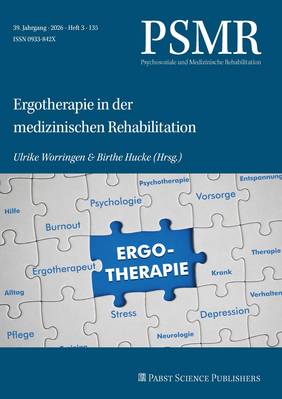
Psychosoziale und Medizinische Rehabilitation
39. Jahrgang • 2026 • Heft 3 (135)
Pabst, 2026
ISSN 0933-842X